Six signs say your commercial kitchen hood needs cleaning now: visible grease on the hood or filters, smoke hanging in the kitchen during normal service, weak airflow at the filters, a stale grease smell that survives a full clean-down, grease showing up on the roof or an exterior wall, and no current service report on file.
Any one of those means grease has moved past the point where the system is doing its job. What none of them tells you alone is where the grease has gone, and that decides whether you need a filter swap, a full professional hood and exhaust cleaning, or a different service entirely. Here is what each sign indicates and what it costs to wait.
The Short Answer: Six Signs, Ranked by How Fast You Need to Act
- Grease on the hood surface or filters: the filters are saturated and the plenum is loading.
- Smoke lingering during normal service: the system has lost capture.
- Weak airflow at the filters: restriction is usually in the duct or the fan.
- A stale grease smell nothing fixes: often the appliance, sometimes the duct.
- Grease on the roof or an exterior wall: a liability and lease exposure, not just a cleaning issue.
- No current service report: a compliance failure even if the system is spotless.
Sign 1: You Can See or Feel Grease on the Hood Surface
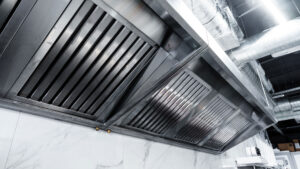
If a finger drawn across the hood canopy comes back tacky, the baffle filters behind it are already past saturation. Baffle filters are the angled metal plates in the hood opening, the first grease removal device in the system, designed to be the sacrificial stage. When grease is on the outside of the hood, the filters have stopped catching it and everything downstream is catching it instead.
This matters more in a Type I hood built for grease-laden vapors than in a Type II heat-and-steam hood, because Type I is the one connected to a duct run that terminates on your roof. Surface grease on a Type I hood means the fuel load has already started traveling.
Sign 2: The Kitchen Holds Smoke During a Normal Service
Not a flare-up. A normal service, on the equipment you run every day, and the smoke sits at the ceiling line instead of leaving. That is a capture-and-containment failure, and it almost always means the exhaust fan is moving less air than it was designed to move because the path it is pulling through has narrowed.
The operational cost shows up first: staff complaints, heat, and a dining room that smells like the line. The real cost is that the same narrowing is where grease buildup becomes a fire hazard. Smoke you can see is the visible half of a problem whose other half is inside a duct you cannot see.
Sign 3: Airflow at the Filters Has Dropped Off
Hold a slip of paper at the filter face during service. If it barely pulls, the restriction is usually the plenum behind the filters, the duct run above, or grease loading on the exhaust fan blades, which throws the fan out of balance and drops its output further.
A cleaning that stops at the hood will not fix this. What a full kitchen exhaust cleaning covers is the whole path: hood interior, filters and baffles, the duct from plenum to rooftop termination, the fan blades and housing, and every grease collection device on the way. Anything less leaves the restriction in place.
Sign 4: A Stale Grease Smell That Cleaning the Line Does Not Fix
A rancid smell that persists after a full clean-down is coming from somewhere the clean-down does not reach. Warm grease film in a horizontal duct run is the usual suspect, and Phoenix summers make it worse: rooftop deck temperatures keep duct grease closer to liquid, so it migrates and it off-gasses. Be honest about this one, though: the smell is frequently the appliance rather than the exhaust. If you cleaned the hood recently and the smell stayed, the exhaust is probably not your problem.
Sign 5: Grease Is Showing Up on the Roof or Down an Exterior Wall
A dark stain spreading from the fan curb, or a streak down the wall below it, means grease is leaving the system where it terminates rather than being collected. That is a containment problem, and the exposure is different: grease on a membrane roof voids roofing warranties, most commercial leases make the tenant liable for it, and stormwater carrying it off the roof adds an environmental issue to the property damage.
The fix is a rooftop grease containment system sized to the fan, maintained on its own schedule. Cleaning the hood harder will not stop grease arriving at the roof.
Sign 6: You Cannot Produce the Last Service Report
This is the sign that costs the most and gets talked about the least. Under NFPA 96, the national standard governing ventilation and fire protection for commercial cooking, a compliant service leaves three things behind: a dated label on the hood naming the technician and the provider, tags at each access panel opened, and a written report delivered within two weeks identifying any area that could not be reached and why.
Without those you cannot demonstrate compliance, and a spotless system with no paperwork fails the same inspection a dirty one does. That report is also what your insurer asks for after a loss. NFPA 96-compliant hood and exhaust cleaning is defined as much by what gets documented as by what gets scrubbed.
What NFPA 96 Actually Requires and Why It Is Not a Cleaning Schedule
Almost every article on this subject presents the NFPA 96 frequency table as a cleaning schedule. It is not. It sets how often the system must be inspected, and it requires cleaning whenever that inspection finds contamination. In the current 2024 edition of the standard, the table is numbered Table 12.4, renumbered from Table 11.4, which is what most published guidance still cites. The minimum inspection intervals are:
- Solid fuel cooking (wood, charcoal, mesquite): monthly
- High-volume cooking (24-hour operations, charbroiling, wok cooking): quarterly
- Moderate-volume cooking (most full-service restaurant lines): semiannually
- Low-volume cooking (seasonal, institutional, light use): annually
Read that correctly and the six signs above stop being a nuisance list and become the actual compliance trigger. If your interval is semiannual and grease arrives in four months, the standard does not give you two more months. It requires the cleaning. That is why how often Phoenix hood systems should be cleaned is a question about your menu and your volume, not about a date on a calendar.
The Two-Fire Problem: Why the Fire You Are Preventing Is Not the One in the Pan
NFPA’s Structure Fires in Eating and Drinking Establishments‘ reports put an average of 7,410 structure fires a year in eating and drinking establishments, 61% of them involving cooking equipment, with 110 civilian injuries and $165 million in property damage annually. The number underneath that one is the one worth your attention.
The report separates confined cooking fires (contained to the appliance) from non-confined fires that spread into the structure. Confined fires run about 3,370 a year and roughly $2 million in total damage. Non-confined fires run about 1,140 a year and cost roughly $60 million. Three times less frequent. Thirty times the damage.
So there are two fires, and they are not the same event. Your suppression system and your staff handle the first. Your hood and duct system decide whether there is a second: a clean duct gives a flare-up nothing to travel on, and a loaded one is a fuel path running from your line to your roof. Every sign on this page reports which of those two fires your kitchen is currently set up to have.
Why Phoenix Kitchens Hit These Signs Sooner
Three Valley conditions compress the interval. Patio and outdoor cooking runs most of the year here, so lines that would be seasonal elsewhere produce grease-laden vapor continuously. Dust loading is real: haboob season drives fine particulate onto rooftop fan housings and into intakes, where it binds to grease film into a deposit harder to remove than grease alone. And summer rooftop temperatures move duct grease further down the run and onto the membrane.
A Phoenix kitchen on the same menu as one in a milder climate will show these signs earlier. If you run restaurant kitchens in the metro and you are working to a national interval you inherited from a corporate standard, the interval is probably wrong for your building. Local operators scheduling hood cleaning across Phoenix should set frequency based on observed grease, not on the calendar.
When a Hood Cleaning Is Not What You Need
Several of the signs above are frequently something else, and the wrong service will not fix them:
- Grease on the roof is a containment failure. You need rooftop grease containment, not a harder scrub of a hood that is already clean.
- A smell that survives a clean hood is usually the appliance’s. Carbonized buildup in a conveyor oven produces it, and conveyor oven cleaning is the service that removes it.
- Persistent haze with clean ducts is often a make-up air imbalance: the building is not replacing the air the fan removes. That is a mechanical contractor’s job, not a cleaner’s.
A vendor who books a full exhaust cleaning for any of those without saying so is selling you the wrong job. Ask which of the four they think it is before you approve the quote, and ask what the last report said about the area in question.
Frequently Asked Questions
How do I know if my restaurant hood needs cleaning?
Check three things during service: whether the hood surface is tacky, whether smoke clears, and whether the filters still pull air. Anyone failing means grease has moved past the filters.
How much grease buildup is too much in a kitchen hood?
NFPA 96 does not set a thickness you are allowed to keep. It requires that grease-laden deposits be removed when an inspection finds them and that cleaned surfaces be restored to bare metal. If you can see or feel a deposit, it is already past the threshold.
What happens if you do not clean a commercial kitchen hood?
Three things, in order: airflow drops and the kitchen gets hot and smoky; the system fails fire and health inspections; and the duct becomes a fuel path that turns a contained appliance fire into a structure fire.
Can I clean the hood filters myself between services?
Baffle filters are designed to be pulled and washed by kitchen staff, and doing it regularly helps. It does not substitute for professional service: filters are one stage of a system running from the plenum to the rooftop fan, and only that full path counts toward NFPA 96 compliance.
Do you service kitchens across the Phoenix metro?
Yes. Gilbert, Scottsdale, Chandler, Mesa, Phoenix, Tempe, and Tucson. Most cleanings run overnight so your line is not disrupted, and every job leaves the labels, tags and written report your next inspection will ask for.
Get an Honest Read on Your System Before Your Next Inspection
Hood Hero is local, family-owned and operated, $5M insured, and staffed by Phil Ackland-certified technicians who are background-checked and drug-screened, which matters when the work happens overnight in an empty kitchen. Every job is held to The Mom Clean Standard™: if it is not right, we come back.
If two or more of the six signs describe your kitchen, get a free compliance check before your next inspection date rather than after it. Call (602) 341-3163 or request service online, and we will look at the whole path (hood, duct, fan and roof) and tell you plainly what it needs.