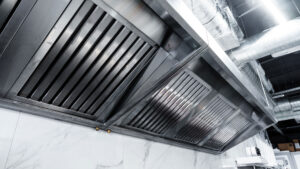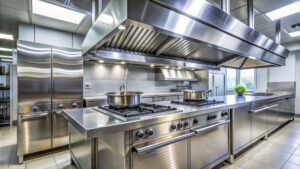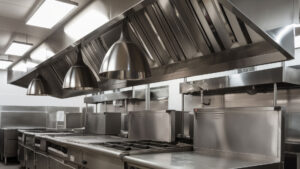
A hotel does not have a kitchen. It has three or four exhaust systems on different clocks (banquet, outlet restaurant, lobby bar or grab-and-go, and employee cafeteria) and NFPA 96 assigns each one its own inspection interval based on what is cooked under it, not on the property’s overall size.
That is the requirement most hotel programmes get wrong, and it is why a property can hold a current cleaning contract and still fail on one, too. Getting hotel and resort kitchen exhaust cleaning right is less about frequency than about inventory: knowing how many systems you have, what each one cooks, and who owns each one contractually.
The Short Answer: What NFPA 96 Requires of a Hotel
- Every Type I hood on the property (the grease-rated hoods) is in scope, including banquet halls, outlets, bars and the employee cafeteria.
- Each system is inspected on its own interval, set by its cooking type: monthly for solid fuel, quarterly for high-volume or 24-hour cooking, semiannually for moderate volume, and annually for low volume.
- Cleaning is triggered by the inspection, not by the calendar. Grease found means cleaning due, whatever the contract says.
- The whole path is in scope: hood interior, filters, duct riser to rooftop termination, fan blades and housing, restored to bare metal.
- Documentation follows every service: a dated label on the hood, tags at each opened access panel, and a written report inside two weeks naming anything that could not be reached.
- The fire suppression system runs separately on its own semiannual cycle.
A Hotel Is Not One Kitchen. It Is Three or Four Systems.
Walk a full-service property and count the Type I hoods. A typical Valley hotel has a main banquet kitchen, an outlet restaurant that may be lease-operated by a third party, a lobby bar or grab-and-go with a small cook line, and an employee cafeteria. Resorts add a pool grill. That is four to five separate hoods, four to five duct risers, and four to five terminations on the roof.
Each one cooks something different, so each one falls in a different tier. A banquet kitchen running charbroilers through wedding season is high-volume. The employee cafeteria is probably low-volume. The lobby grab-and-go might be moderate. A single property-wide interval either over-serves the cafeteria or under-serves the banquet line, and it is the second failure that shows up in an inspection. A commercial hood and exhaust cleaning programme for a hotel starts with an inventory, not a frequency.
Which Tier Each System Falls Into
NFPA 96 sets how often each system must be inspected and requires cleaning whenever that inspection finds contamination. In the current 2024 edition the table is numbered Table 12.4, renumbered from Table 11.4, which most published guidance still cites. The minimum inspection intervals:
- Solid fuel (wood-fired oven, mesquite grill): monthly
- High-volume or 24-hour cooking (banquet charbroiling, wok cooking, a line that never closes): quarterly
- Moderate-volume (most outlet restaurants and bar cook lines): semiannually
- Low-volume (employee cafeterias, seasonal outlets, light use): annually
Seasonality is the hotel-specific wrinkle. A banquet kitchen that is quiet in August and runs four hundred covers a night in March does not have one cooking profile. It has two. Programmes that work set the banquet system’s interval to its peak, not its average, and hold the inspection before the season rather than after it. That is what NFPA 96-compliant hood and exhaust cleaning looks like when the load is not constant.
The 24-Hour Problem: There Is No Closed Window
A restaurant closes. A hotel does not. Room service, early breakfast and late banquet breakdown mean the only genuine window is a narrow overnight block, and it may be the same block housekeeping and engineering want. Hood cleaning also needs the equipment cool and the line empty, which pushes it later still.
Sequencing is what makes it workable. One system a night across a week, starting with the banquet kitchen while the outlet is on its own interval, keeps the property running and gives each crew a full window rather than a rushed one. Properties that try to do everything in a single night usually end up with one system half-finished and a report that says so.
Scheduling is therefore the real constraint, not the work. Knowing how long a commercial hood cleaning takes for each of your systems is what lets you sequence them across several nights instead of attempting the property in one night. Most programmes that fail, fail on calendar collisions rather than on standards.
Access, Escort and Background Screening
This is the requirement procurement cares about and content on this topic never mentions. Overnight work in an occupied hotel means technicians move through the back of house, past guest floors and onto a roof, often escorted by a night manager and sometimes keyed in unaccompanied. The people doing it are working in your building while your guests sleep.
Background-checked and drug-screened technicians stop being a marketing line and become a procurement requirement. So does a certificate of insurance naming the property and a crew that signs in and out. Hotels sit alongside hospitals and schools in the category of mission-critical and high-security environments where who is admitted matters as much as what they do once inside.
Rooftop Grease Is a Guest-Facing Problem at a Hotel
Four or five terminations mean four or five places grease can leave the system. In a hotel the consequences run further than in a standalone restaurant: staining on a membrane roof voids roofing warranties on a building far more expensive to re-roof; drainage carries grease towards pool decks and landscaping; and at a Valley resort the roof is frequently visible from upper guest rooms and event terraces.
Cleaning the hoods harder does not stop grease arriving at the roof. Rooftop grease containment sized to each fan and maintained on its own schedule is the control, and on a multi-fan property it belongs in the same programme as the hood work rather than being handled ad hoc when a stain appears.
What Valley Resort Kitchens Deal With
Phoenix metro properties face conditions national standards do not anticipate. Pool grills and outdoor banquet cooking run most of the year, so systems that would be seasonal elsewhere produce grease-laden vapour continuously. Summer rooftop temperatures keep duct grease closer to liquid, moving it further down the run and onto the membrane. Haboob season drives fine particulates onto fan housings, where they bind to grease film into a deposit harder to remove than grease alone.
There is a jurisdictional wrinkle too. The City of Phoenix adopted the 2024 International Fire Code effective February 17, 2026. Arizona has no statewide commercial fire code (adoption is municipal) so a group with a property in Phoenix and another booking hood cleaning in Scottsdale should confirm the adopted edition with each city’s fire department rather than running one assumption across the portfolio.
Building the Vendor Spec: What to Require
If you are writing or reviewing a specification, these are the clauses that separate a programme from a purchase order:
- A system inventory, not a property-level price. Every Type I hood listed, with its cooking profile and its assigned interval.
- Certification named Phil Ackland or IKECA (CECS/CECI). Whether your cleaner is certified determines whether their report satisfies the authority having jurisdiction.
- Bare metal specified, with photo documentation before and after per system.
- Access panel remediation is quoted separately: missing or painted-over panels are sheet metal work that must happen before a full cleaning is possible.
- Written report inside two weeks, naming any area not reached and the reason why. That clause is what makes an inaccessible duct a documented action item instead of a silent gap.
- Background-checked technicians and a certificate of insurance naming the property.
- Overnight scheduling committed in writing, sequenced across systems.
Most of that list is standard practice for a serious provider and impossible for a cheap one, which is the point. There is more on choosing a kitchen exhaust cleaning company worth reading before you shortlist.
When Hood Cleaning Is Not the Answer
Three complaints reach facilities directors regularly that a cleaning will not resolve:
- Kitchen odour reaching a guest corridor or lobby is almost always building pressurisation or make-up air, not grease. A clean system moving the wrong volume of air still pushes odour where you do not want it, and that is a mechanical engineering fix.
- Smoke or smell from a conveyor oven is the appliance, and conveyor oven cleaning is the service that addresses it.
- A lease-operated outlet restaurant’s exhaust is frequently the tenant’s contractual obligation. Check the lease before you pay for it, and check that they are actually doing it because the hood is still on your roof and in your building.
Frequently Asked Questions
How often should hotel kitchen hoods be cleaned?
Each system is inspected on its own interval: quarterly for high-volume or 24-hour cooking, semiannually for moderate-volume outlets, and annually for low-volume cafeterias and cleaned whenever that inspection finds grease. A property will usually run several intervals at once.
Do hotel kitchens follow the same NFPA 96 rules as restaurants?
Yes. NFPA 96 applies to commercial cooking operations regardless of building type. The difference is scale and structure: a hotel has multiple systems in different tiers, plus 24-hour operation and access constraints a standalone restaurant does not have.
Who is responsible for hood cleaning in a leased hotel restaurant?
It depends on the lease, and it is worth confirming in writing. Many leases assign exhaust maintenance to the tenant while the duct and rooftop fan remain the landlord’s asset, which means the hotel carries the risk even when the tenant carries the obligation.
Can hood cleaning be done without closing the kitchen?
Yes, but not without a window. Equipment must be cool and the line empty, so the work runs overnight and is sequenced across several nights on a multi-system property rather than attempted in one.
Do you service hotels and resorts across the Phoenix metro?
Yes. Gilbert, Scottsdale, Chandler, Mesa, Phoenix and Tempe, plus Tucson. Multi-system properties are scheduled overnight across consecutive nights, and every system gets its own labels, tags and written report.
Put Every System on the Right Schedule
Hood Hero is local, family-owned and operated, $5M insured, and staffed by Phil Ackland-certified technicians who are background-checked and drug-screened, which is why hotels, hospitals and schools let us into the building overnight. Every system is held to the Mum Clean Standard™: if it is not right, we come back. Maintenance programme properties get locked-in rates and priority scheduling.
If you are not certain how many Type I hoods your property has or which tier each one belongs in, start with a free compliance check. Call (602) 341-3163 or request service online, and we will walk every system, build the inventory, and give you a schedule you can hand to procurement.